Restorations
Interrupted Solitude / Soledad Interrumpida (1975, Ed Emshwiller)
National Film Preservation Fund - Avant-Garde Masters Grant Recipient (with the Library at the California Institute of the Arts
“The real grabber of the group was ‘Soledad Interrumpida’ .... Red, black and white projections from three sources covered a screen and adjacent walls with shapes ranging from abstract to stylized and distorted ranks of nude bodies, all in constant, pulsing, seething motion, while two tape sources provided lip-smacking, whining, motorboating, dopplering, puffing, chirping and other varieties of sonic ambience .... The combined effect was steadily mounting tension....”
– Herman Trotter, Buffalo Evening News, Monday, May 5, 1975
Research Significance: Between roughly 1964-1980, the Center of the Creative and Performing Arts at the State University of New York (SUNY) at Buffalo was a dynamic cultural oasis drawing among many unique talents, filmmaker Ed Emschwiller. Beginning with a background in art and illustration, Emshwiller was engaged with the action painting school (defined by artists such as Jackson Pollock, Willem de Kooning and Robert Motherwell) which translated into his cinematic work, exhibiting abstract expression akin to dance and celebrating fluid movement and kinetic action. Emshwiller’s work remained fundamentally concerned with a body in motion, never in stasis, always in perpetual transformation suggesting a sensibility that we are all externalized, always mediated and indivisible from our sensorial surroundings.
Ed Emshwiller was a key member of the New American Film Movement, an influential experimental branch of the New American Cinema exploring new directions in narrative film. He was also a passionate advocate for avant-garde film, serving on the board of directors of the Film-Makers’ Cooperative and a founding member of the Association of Independent Video and Film-Makers in New York in 1974. Around the same time he was appointed to the Public Media panel of the National Endowment for the Arts. This was a funding panel that granted public monies to museums, public broadcasting and the American Film Institute, channeling access, visibility and recognition for experimental cinema.
While a resident at the Center of the Creative and Performing Arts, Spanish composer Luis de Pablo was introduced to Emshwiller and the two struck up a friendship. The Center asked de Pablo to make its North American début Soledad Interrumpida, a collaborative multi-media performance piece de Pablo had created with sculptor José Luis Alexanco. Drawing on the visceral style of Emshwiller’s work, de Pablo asked Emshwiller to contribute a filmic component, resulting in a three-projector performance piece created for the third act. Utilizing the Emshwiller elements, Soledad Interrumpida was staged in the United States three times in 1975. Afterwards Emshwiller would move to the West Coast where he accepted a key faculty position with the California Institute of the Arts (CalArts), and turning his creative production toward the electronic, embracing video and 3-D computer animation which would define his work for the rest of his career. The photo-chemical print elements remained at the University at Buffalo in the Music Library where they would represent the last films he produced.
“The film will be projected on three screens; one projector will aim the film images at a series of mirrors, which will reflect the film to a screen. Thus, a projectionist becomes a live performer.”
–Thomas Putnam, Buffalo-Courier Express, Sunday, May 4, 1975
Interrupted Solitude / Soledad Interrumpida opens a window into an early and forgotten chapter of multi-sensory media immersive experience. The films and their connective history with de Pablo’s score and Alexanco’s sculptures offer a multitude of entry points for academia, historians and media preservationists, providing a referential and historical template for the contemporary preservation of contemporary electronic and performative media. We view the restoration of these films as a two-step process: material and performative. We have engaged the USC Hugh M. Hefner Moving Image Archive to assist in recreating the performative aspect of the projection and its dynamic projector configuration. Time is, however, of the essence as the fragility of the material elements deem this part of the restoration a priority.
Without these efforts toward preservation, this unique piece of Emswiller’s creative work runs the risk of becoming a historical footnote at best, or at worst, lost. We believe the film elements of Interrupted Solitude / Soledad Interrumpidaare an essential candidate for a National Film Preservation Foundation Avant-Garde Masters Grant.
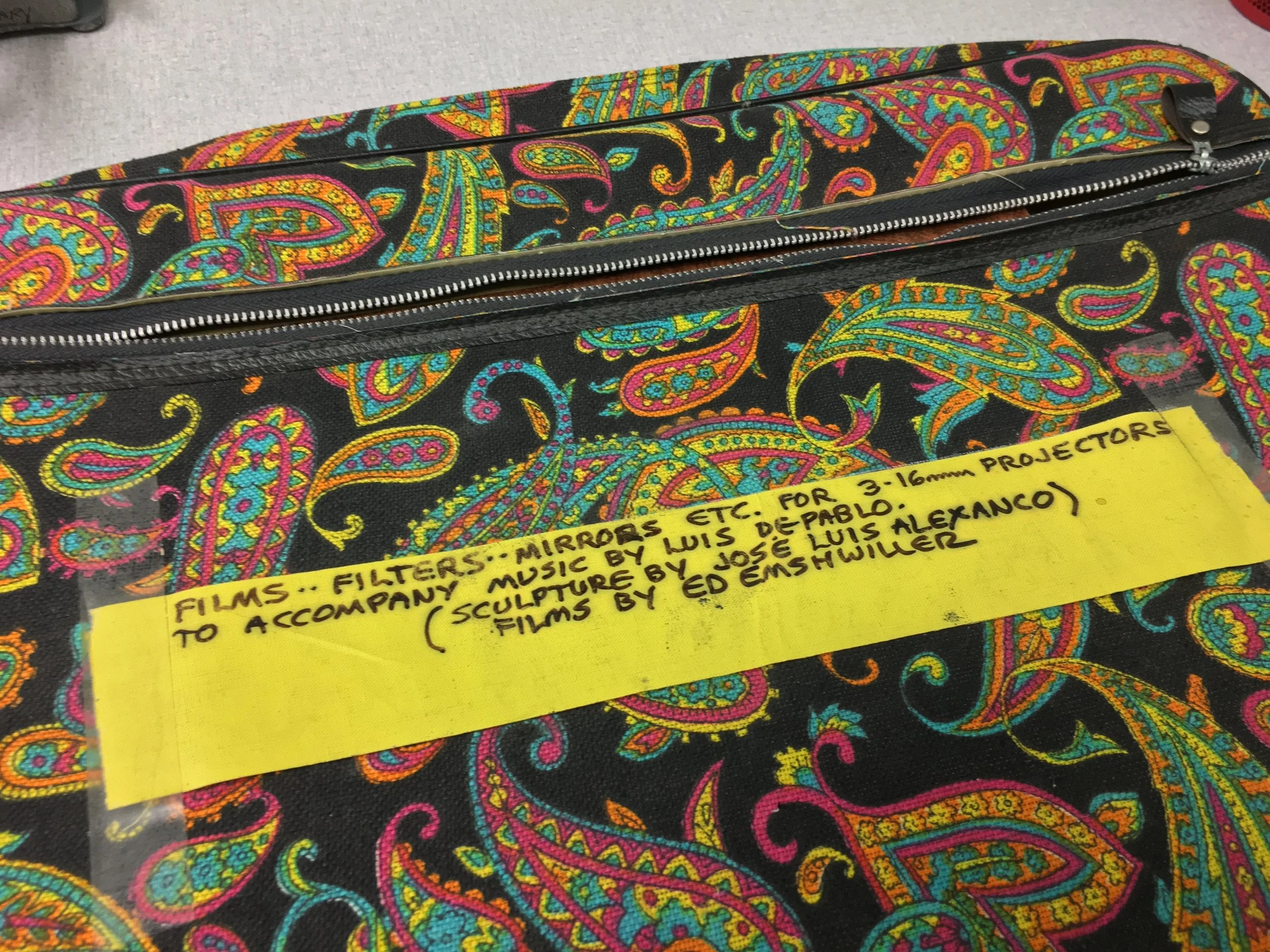
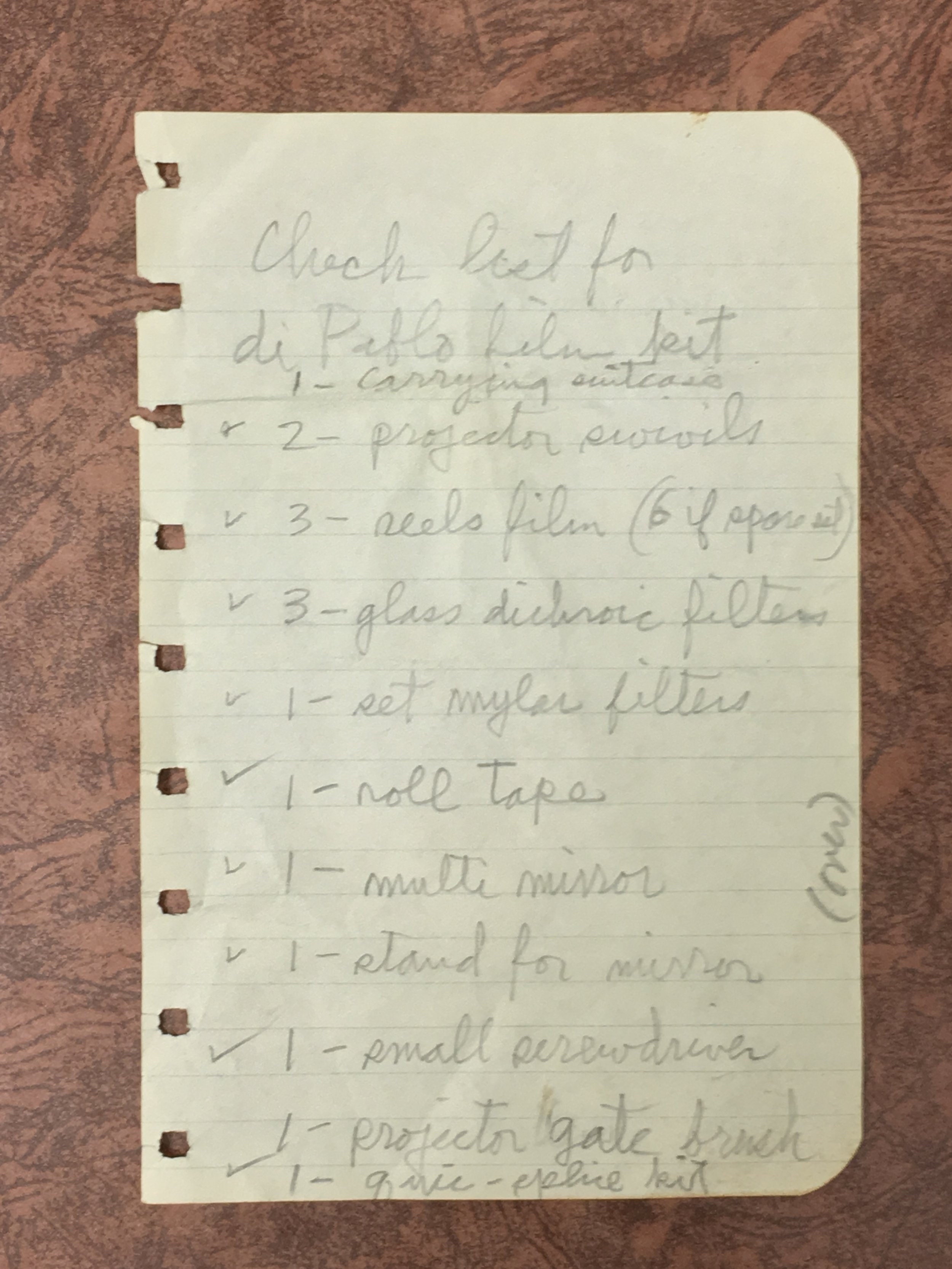
Uniqueness of the CalArts Film Copy: In 2007 the University at Buffalo sent the three photochemical prints to CalArts along with a paisley ‘70’s one-of-a-kind travel suitcase with Emshwiller’s performance artifacts (filters and handmade projector bases) – evidence of the uniqueness of these prints – where they have since remained. Their unique quality and condition render them inaccessible. We very much want to reverse this situation by preserving the photochemical elements, assembling contextual information regarding the performance and creating archival access points to the media.
We have attempted to locate elements, original or otherwise, from the film archives at Museum of Modern Art in New York and Anthology Film where Emshwiller’s collected cinematic work resides, but without any luck. Attempts are continuing but so far, all indications are that the three reels may well be the only surviving elements – which isn’t unreasonable considering that it was staged for a limited East Coast run. Inspection of the prints reveals that India ink was hand applied to eliminate light leaks in the opaque abstract sequences, further suggesting its uniqueness.
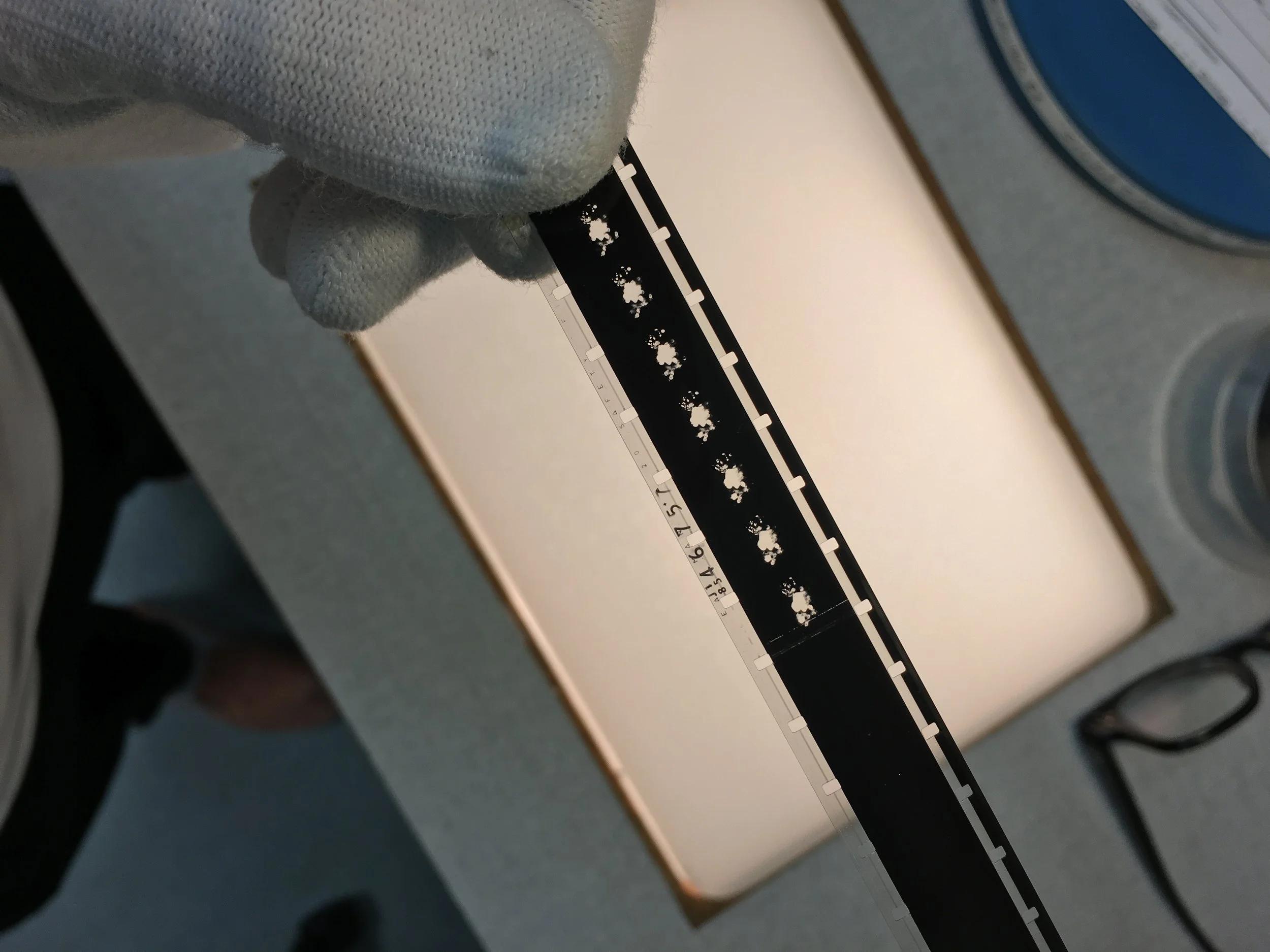
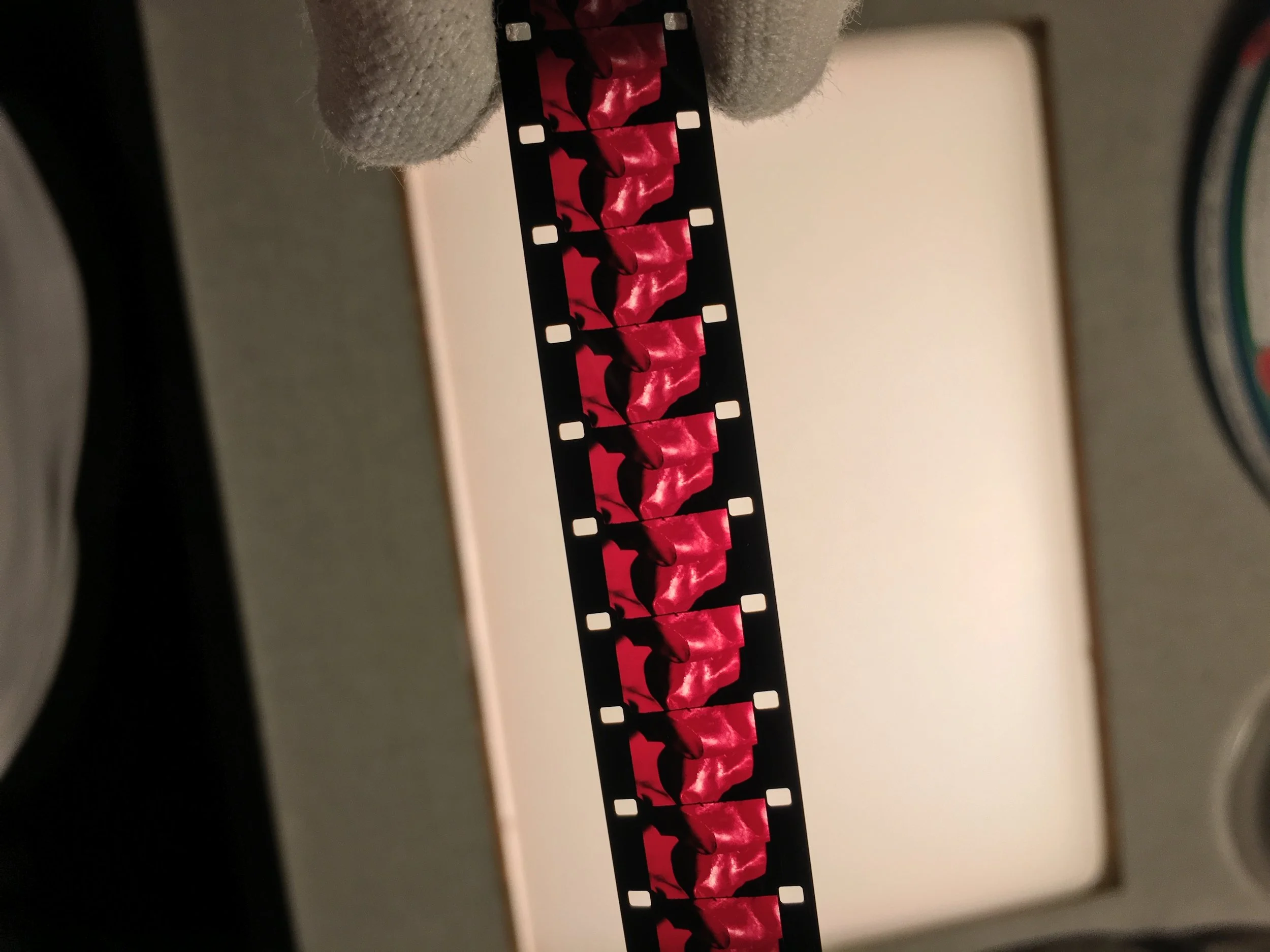
Physical Film Description: The source material consists of (3) 16mm master positive prints, 775ft each, each one issilent. The elements are entirely intact, no splices, and no perf damage, or base or emulsion scratches. There is no sign of projector damage or use. The image density remains sharp and the color reel is vibrant. Luckily, no repairs are required, making the prints an excellent candidate for phot-chemical restoration. However, the condition of the base element is expressing the early stages of acetate film base deterioration (AD strips point to Level 1 base emulsion deterioration) with two of the prints showing variable signs of initial but visible stages of warping and curling -- which makes preservation at this time an essential step.
The CalArts Library collects, maintains, and provides access to moving image collections that support the Institute’s mission and curriculum of all six schools; Art, Critical Studies, Dance, Film / Video, Music and Theater. The collection is not only the access point for students, faculty and staff of the institute, but it presents an outward face to the greater academic and research community. Interrupted Solitude / Soledad Interrumpida will be available to anyone following the general policy for our film collection, either as a proxy viewing copy or as screened in the CalArts Bijou theater. Print loans will be allowed by special request through the Visual Arts Librarian.
Finally, the contextual backstory of the original performance along with the resulting restoration can function as a prime use-case narrative for similar projects. Marrying the film and its original contextual relevance will be promoted through an active pursuit of professional organizations, in publications and conferences, outlining the unique history of, and the subsequent challenges of preserving, the performative and material elements of Interrupted Solitude / Soledad Interrumpida. We believe this will firmly attract interest in the professional community and engagement with the film elements.
4K scans have been generously donated by the USC Hugh M. Hefner Moving Image Archive.